John MacArthur explains the Good Shepherd illustration in light of John 9:
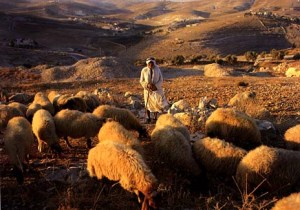 The life of a Palestinian shepherd was hard, very hard. There’s very little grass and the sheep have to move from place to place constantly to find the grass that is available. And there are no protecting walls on the plateau and very often the sheep would drift to the edge and find themselves down in some ravine or some little valley and the shepherd would have to wind his way down the hillside to find the sheep, pick it up and carry it back to the plateau again. And then there was always the problem of the danger of wild animals, particularly wolves, the problem of thieves and robbers who stole the sheep. This went on all the time. And so a shepherd had to maintain constant vigilance, fearless courage, patience and a love for his flock. These were the necessary characteristics of a shepherd. He had to care for them, not just stand there and watch them. And in the Old Testament, God even used this analogy. He calls Himself the shepherd of Israel and Israel is His flock. The psalmist said, “The Lord is my shepherd, I shall not want.” The psalmist said in Psalm 77, “Thou leadest Thou people like a flock.” In Psalm 79, “We, Thy people, the sheep of Thy pasture, will give Thee thanks forever.” In Psalm 80, “Give ear, O shepherd of Israel,” the psalmist said, “Thou that leadest Joseph like a flock.” Psalm 95, “He is our God and we are the people of His pasture and the sheep of His hand.” God was a shepherd to Israel.
 That same analogy carried itself into the New Testament and Jesus Christ calls Himself a shepherd and His own church His flock. He is the shepherd who will risk His life to seek and to save that one lost sheep, Matthew 18. He is the shepherd who has pity upon the people because they are as sheep having no shepherd, Matthew 9. He is the shepherd who called His disciples a little flock, Luke 12. And when He, the shepherd, was smitten, you remember, He said in Mark 14, quoting the Old Testament, “When the shepherd was smitten, the sheep are scattered.” Peter says He’s the shepherd of our souls. And the writer of Hebrews says He is the Great shepherd of the sheep.
So this idea of tender care of a shepherd who tends his flock was used to describe the attitude of God toward Israel and of Jesus Christ toward His own beloved chosen ones, the church. The shepherd illustration then, so much a part of Israel becomes the vehicle for the discourse of chapter 10. Without a break or a pause, Jesus goes right into it.
Now His audience is a mixture. First of all, the disciples are there. Secondly, the formerly blind beggar is there. Thirdly, the Pharisees are there, antagonistic and hostile as ever. And fourthly, there was a scattering of Jews there. This we learned from chapter 9. The Pharisees and the Jews had set themselves up as leaders of the people. They had all the answers. They were the shepherds, so Christ takes this passage to show them they are not the shepherds but that He is alone the true and good Shepherd. And all the rest are nothing but thieves and robbers.
Now Jesus speaking to them does not speak directly. He speaks to them in what verse 6 says is a parable. Now this is not actually a parable at all. The word for parable is not this word. Now the King James translators have translated it parable because it can’t be translated into English. It’s an untranslatable word. The word for parable is a very simple word. This is the word paroimia, completely different word. It does not mean the same as a parable and I want to give you a shade of difference just for your scholastic understanding. A parable is like a metaphor, the kingdom of heaven is like unto a man, or something like that. When the word “like” or “as” is used, that’s a parable, or a metaphor. This is not that. This…He doesn’t say, “I am like a shepherd, He says I am the shepherd. He doesn’t say I am like a door, I am the door. This is more of a simile. A paroimia is like a simile.
Now Jesus often spoke, and whether it’s a parable or a paroimia is not really the key, the thing that we want to understand is this, incidently, there are no parables in John, none at all, and John doesn’t have one here, he uses the word paroimia, but what we do want to understand is this, whenever Jesus speaks in a parable, metaphor, or a paroimia, simile, He does it for two reasons. He does it, number one, so that some won’t understand; number two, so that some will understand. Otherwise He would speak in simple terms, but He does this to reveal and to conceal. And so He speaks in a paroimia here. Now what sets this up very simply is this, in verse 39 to 41 of chapter 9 Jesus had told the Pharisees that they were blind, that they could not see, could not understand Him. Now that’s very important. He’s told them this before, hasn’t He? And they illustrated it. “You don’t ever get the message, you don’t understand. You are blind, you do not understand.” Then to illustrate that they don’t understand, He speaks in a very clear and very lucid paroimia and sure enough, they don’t understand. See. What He’s attempting to do is illustrate to them the truth of His statement that they are blind. Now the others who are there, the disciples and the blind beggar, evidently they understood the message. It’s obvious. But the Pharisees who have been blind by their own willful unbelief, blinded judicially by God, let them alone, Jesus said, they’re blind leaders of the blind, they are then face to face with a living illustration that indeed they are blind. And when you get down to verse 6 it says, “They understood not.” And so the paroimia is a great way to illustrate their blindness to them. And that’s the purpose it serves, first of all.
The second purpose, and always the purpose of a parable or a paroimia, was to reveal the truth to those who could see. You see? When I read this passage I understand it perfectly. When an unbeliever reads it, he doesn’t understand it at all. For those who do know, this teaches some glorious truth. And before we’re done this morning, if you’re a Christian you’re going to see a beautiful, thrilling relationship between you and Jesus Christ as a sheep to a shepherd. Just thrilling. And you understand it. Now in this particular paroimia there’s a shift of thought many times, and you have to be careful with these paroimia or parables that you don’t try and push everything into a little box and make it all come out just like this, you know. These are just illustrations, they have to be used naturally and generally, not little specifics and, boy, some people just go to town with the parables and they’ve got every little thing meaning something. We have to consider them generally and in a natural flowing way. This is not an easy passage to interpret, in spite of the lucid character of Christ’s terms. There are some problems in it. I hope that by the time we’re done you won’t even recognize the problems, that we have covered them well enough in terms of trying to say exactly what Christ said so that you won’t even notice them.
All right, two aspects, and we’re going to divide the passage into two parts. We didn’t bother with a printed outline this morning, it’s too simple, really. The first six verses, 1 to 6, the shepherd to the sheep. Jesus claims to be the shepherd to the sheep, first six verses. Verses 7 to 10 He claims to be the door to the fold. The shepherd to the sheep, then the door to the fold.
Beginning then in verse 1, the shepherd to the sheep. Christ’s first claim is to be the shepherd to the sheep. And this, you see, is in contrast to the false shepherds to whom He’s been talking. And it’s very picturesque. Verse 1, “Verily, verily,” whenever you read that, that’s serious solemn and He means listen carefully, this is serious solemn truth. “Verily, verily I say unto you, he that entereth not by the door into the sheepfold but climbeth up some other way the same is a thief and a robber. But he that entereth in by the door is the shepherd of the sheep.”
Now here you have a sheepfold, you have a door, you have a thief and a robber and you have a shepherd. Now what does all this mean? Well, first of all, in order to understand the interpretation of the paroimia we have to understand the exact physical meaning here. What was a sheepfold? What was a shepherd? What was a door? And what was a thief and a robber? And then we can make the analogy spiritual.
In Palestine there was in each village, and this had gone on for centuries, in each village located as the common property of the village in the center somewhere, a common sheepfold. And all of the shepherds in that village who would have their sheep out grazing on the hillside would at night lead their sheep into the sheepfold. There was a man who was hired to care for the sheepfold during the night and he was called the porter. And all the sheep would be led into the fold and they would spend the night there while the shepherd went home. The porter’s job was to shut the door and to be in front of the door on guard lest animals or thieves and robbers would come to steal or slaughter the sheep.
Now when they would bring their sheep in, something very, very beautifully symbolic happened. The shepherd would come to town with his sheep to the little village, he would come to the entrance to the large sheepfold which would house all the sheep. You say, “Didn’t they get mixed up?” No, because they all knew their own name when their master spoke, and we’ll see that in a moment. But nevertheless, the shepherd would bring all of his sheep up to the door, then he would take his rod, a long rod, all shepherds had a rod, and he would put it down over the door very low so that the sheep could not get under it. And he would stop the sheep and he would check over the whole body of the sheep to make sure there was no hurt or no injury. And if the sheep was fine, he would lift the rod and the sheep would pass under the rod. He did that with every sheep every night.
You say, “Why is that important?” Just this, in the Old Testament, Ezekiel chapter 20 verse 37, don’t look it up, just listen to this thought, beautiful thought. God says through Ezekiel, “Some day I’m going to gather Israel and I’m going to bring Israel into the Kingdom,” right? And he said this, verse 37 says, “Israel will pass under the rod into a secure place.” That’s not a rod of judgment, friends, that means that before Israel ever enters the Kingdom, the great Shepherd of Israel is going to stop every sheep and check and make sure there’s no scratch, no hurt, no injury. You see, that’s the care that God has for His own.
And so, the shepherd would check his sheep and he became familiar with them. And the porter would accept the sheep, lock the gate. The shepherd would go home. In the morning the different shepherds would come to get their sheep. And the shepherd would speak to the porter and the sheep would perk up, they recognize their shepherd’s voice. And then he would call them by name and they would follow him and they would go back out to pasture.
Now, you see, only the shepherd could get in through the door. The porter wouldn’t let a thief and a robber in, only the shepherd could get in through the door. And so the thieves and the robbers, in order to get the sheep, would have to climb the wall. See that? Look at verse 10, “He that entereth not by the door to the sheepfold but climbeth up some other way, the same is a thief and a robber.” They couldn’t get in the door because the porter wouldn’t let them in. And so they would have to climb the walls to get in to steal the sheep. But the shepherd would go in the door and the thieves would have to climb over the wall in order to get the sheep that he wanted to steal. Very often they would slaughter the sheep right in the sheepfold to keep the sheep from making noise. And they would throw the dead sheep over the wall if the porter happened to be asleep.

