Pastor Coty Pinckney in a sermon, “The King and His Kingdom” comments:
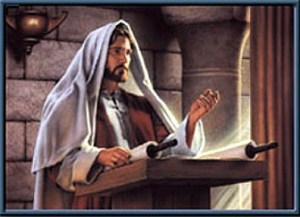 Jesus enters the synagogue on a Sabbath, takes the Isaiah scroll, and unrolls it to what we call chapter 61. Note that this section of Isaiah is about the Kingdom of God. Consider the verses that immediately precede what Jesus read:
Violence shall no more be heard in your land, devastation or destruction within your borders; you shall call your walls Salvation, and your gates Praise. . . . The LORD will be your everlasting light, and your God will be your glory. . . . Your days of mourning shall be ended. 21 Your people shall all be righteous; they shall possess the land forever, . . . that I might be glorified. 22 The least one shall become a clan, and the smallest one a mighty nation; I am the LORD; in its time I will hasten it. (Selections from Isaiah 60:18-22)
Jesus then reads:
“The Spirit of the Lord is upon me, because he has anointed me to proclaim good news to the poor. He has sent me to proclaim liberty to the captives and recovering of sight to the blind, to set at liberty those who are oppressed, 19 to proclaim the year of the Lord’s favor.” Luke 4:18-19
After giving the scroll back and sitting down (Jewish teachers normally sat down while speaking), Jesus says,
“Today this Scripture has been fulfilled in your hearing.” Luke 4:21
He says, “The kingdom is here! I am the Anointed One, the One sent to proclaim the Good News! The time is come!”
But what kind of kingdom is this? An earthly kingdom where the Jews throw off Roman oppression? The restoration and expansion of an empire larger than David and Solomon’s?
Note that the emphasis in the Isaiah passage is not on political power but on the close relationship between God and His people, so that He might be glorified. Indeed, Jesus is proclaiming “Good News,” He is proclaiming Gospel; He proclaims “the year of the Lord’s favor,” God’s grace on His people; He gives “sight to the blind” – and often Scripture uses spiritual blindness as a picture of sin. All these promises can be taken as spiritual promises, with a spiritual fulfillment.
What about the proclamation of “liberty to the captives” and liberty to the oppressed? Even here there are spiritual connotations. The word translated “liberty” appears fifteen other times in the New Testament (eight of these are in Luke’s writings). Every other occurrence of this word is translated “forgiveness.” We’ve encountered this word twice already in Luke, in chapter 1 verse 77 in Zechariah’s song, and in chapter 3 verse 3 describing John’s ministry: He proclaims a baptism of repentance for the forgiveness of sins.
- Indeed, the greatest bondage of the people is not to Rome, but to sin.
- The greatest liberty Christ can offer is spiritual freedom, freedom from bondage to sin.
So the most important benefits of the Kingdom are spiritual: Spiritual freedom, spiritual sight.
But even though political freedom and physical sight are of lesser importance, surely the ultimate triumph of the Kingdom includes them. However, this ultimate triumph has not been fulfilled even today, two thousand years after Jesus. So what did Jesus mean when He told the people of Nazareth, “Today this Scripture has been fulfilled in your hearing”?
In order to understand the New Testament, we must understand the “already/not yet” character of the Kingdom. As Jesus proclaims here, the Kingdom has arrived with the ministry of Jesus. Yet the complete fulfillment of all the promises of the Kingdom awaits His second coming. Throughout this time between His first and second comings, the Kingdom is already here, but is not yet fully realized.
Why? Why didn’t Jesus usher in the final Kingdom in 30 AD? Why didn’t He end history at that time?
Consider: What happens if the Kingdom comes before Jesus dies on the cross? Remember, in the final Kingdom there is perfect justice. Perfect righteousness. But Paul tells us, “There is no one righteous, no not one” (Romans 3:10). Thus, in a crossless Kingdom of perfect justice, there are no human citizens. So if men and women are to inhabit the kingdom, the final fulfillment of the Kingdom must await Jesus’ death and resurrection.
That explains why Jesus had to suffer and die; that explains why He could not usher in His kingdom during His lifetime on earth. But why didn’t He come back shortly after His death? Why didn’t He come back in, say, 50 AD? Or 500 AD? Or 1500 AD?
At any of those points, some humans would have been forgiven. There would have been human citizens of the Kingdom. But the Kingdom would not have included those from every tribe and tongue and people and nation. The promise to Abraham – that all the families of the earth would be blessed in him – would not have been fulfilled. As Jesus says later,
And this gospel of the kingdom will be proclaimed throughout the whole world as a testimony to all nations, and then the end will come. Matthew 24:14
So Jesus will not return until this is fulfilled. Every tribe and tongue must stand before the throne of God.
In sum, then, consider the already/not yet nature of the Kingdom promises:
- Jesus offers complete forgiveness of sins now.
- He offers complete freedom from slavery to sin now.
- He offers partial purity from sin now, and complete purity later.
- He offers occasional physical sight to the blind and healing from disease now, and promises us new, incorruptible bodies later.
- He offers us a glorious but somewhat obscured view of Himself now; then we shall see face to face (1 Corinthians 13:12).
Jesus’ preaching, then, completes John’s preaching. He says: “The Kingdom is here! It is inaugurated! I am the promised One! So respond! Turn! Repent! Believe in Me! The one who believes will have forgiveness! Liberty! Sight! You will have God Himself! And eventually you will have political freedom, freedom from disease, freedom from slavery to corruption.”
During this already/not yet era of the Kingdom, that message continues to hold. Do you have that liberty? Have you responded?
 Knowing God through His Word ... Day by Day