Bob Deffinbaugh comments on John 7:45-52
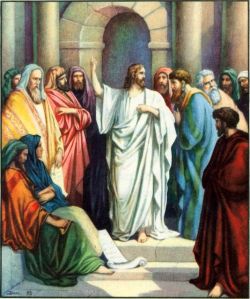 Can’t you just see it in your mind’s eye? These fellows march dutifully to the temple, where they know Jesus can be found. They begin to press their way through the crowd so they can arrest Jesus and deliver Him to those who have dispatched them. As they work their way through the crowd, they cannot help but overhear Jesus as He speaks. In my mind’s eye, I can see one of the officers stop for a moment, so as not to miss what Jesus is about to say next. Turning to his colleagues, he sternly insists that they hush—they are making so much noise he can’t hear Jesus speak. Eventually, all of the police are standing in the crowd, transfixed by His every word. Jesus finishes teaching for the day and leaves, as do the crowds. Then, and only then, do the soldiers remember what they came to do. They are not going to go after Jesus and arrest Him! And so they return to the chief priests and Pharisees to get the scorching they expect.
John tells us very little about these matters, but something like this must have happened. They do come back empty-handed, and their only excuse is that they have never heard anyone speak as Jesus did. Some are not moved at all by His words. Others come to view Him as the Prophet; others as the Messiah. The temple police do not say who they think Jesus is, but they know they have never before seen or heard anyone like Him.
The temple police are not disappointed; they do receive a scorching from the Jewish religious leaders who are frustrated, angry, and amazed. How can these fellows be so gullible? “You have not been deceived also, have you?” Whoever speaks for these religious leaders speaks for the entire group, and his words must send chills up the spines of the temple police … and Nicodemus! “Do you see even one of us—your religious leaders, the most knowledgeable experts on the Old Testament—believing in Jesus? It is only these stupid commoners—worthless and cursed people that they are, who do not know the Scriptures as we do—who follow him. How can you be so stupid? No one with a head on his shoulders believes in Jesus—isn’t that right?”
It seems as though whoever is speaking turns to his colleagues and then looks Nicodemus right in the eye. Does he sense that Nicodemus has been taken in by Jesus? Does he know of the secret interview Nicodemus had with Jesus? Can he discern a change in this teacher’s message? Nicodemus feels the need to respond. All he needs to say are two words—“I do.” Here is his opportunity to declare his faith in Jesus, but he keeps quiet. Instead, he takes the more politically correct stance—he questions the process by which Jesus was judged a wrongdoer. “We haven’t really carried out due process, have we? After all, the law requires that a man not be condemned without giving him a fair trial, and the chance to speak in his own defense.” Nicodemus is right, of course, but it is the cowardly thing to do. He does not acknowledge his faith in Jesus, or at least his considerations that Jesus might be the Messiah.
Now it is Nicodemus who is in for a scorching. Even though half-hearted and evasive, Nicodemus has not taken a firm stand with the others. He has at least expressed doubts and concerns about their condemnation of Jesus and their determination to kill him. And so his colleagues turn on him. “What? Are you saying that you are from Galilee too, that you are as stupid and gullible as that rabble?” And then come the most amazing words, “Investigate carefully and you will see that no prophet comes from Galilee” (verse 52). The great Greek scholar, A.T. Robertson, comments: “As a matter of fact, Jonah, Hosea, Nahum, possibly also Elijah, Elisha, and Amos were from Galilee.”70
 Knowing God through His Word ... Day by Day